

For Freedom
I am like the felled tree, which sprouts: because I still have life

Welcome to new subscribers and regular readers! Thank you for joining me for today’s song, “For Freedom” by Joan Manuel Serrat (1969). Below, you’ll find my interpretation of the lyrics which are written in italics and a YouTube video of the song below the article. For Japanese students, vocabulary words in bold are provided in Japanese below.
✳️ Note: The level of this article is for students with a TOEIC of 550+, Eiken Pre-1, CEFR B2. For Japanese students, vocabulary words in bold are provided in Japanese below.
The song for today is “For Freedom”. It was written by Joan Manuel Serrat in 1969. The article below is an abridged version of the original written by Andrea Eschen. She has graciously agreed to co-author this article. You can find the original here:

“For Freedom” by Joan Manuel Serrat (1969)
(678 words)
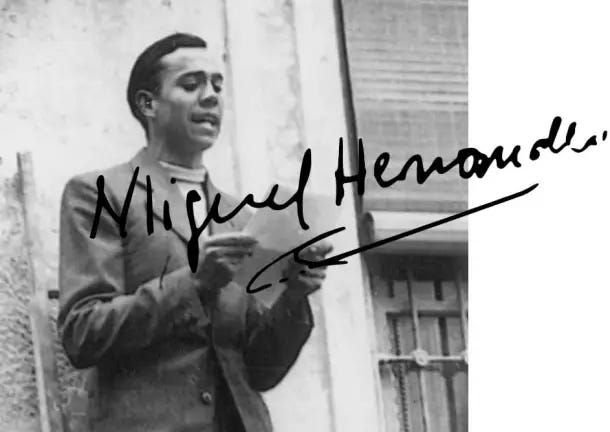
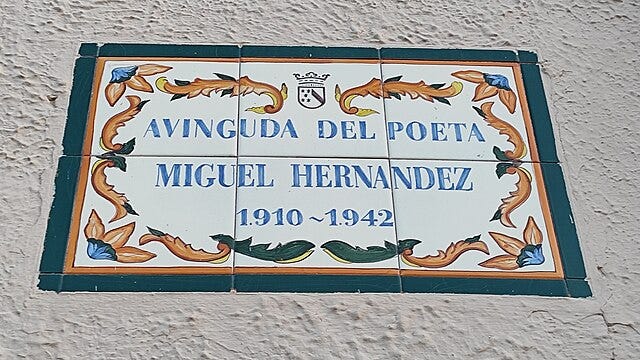
In Madrid’s Parque Oeste you can see a statue that honors one of Spain’s most famous poets, Miguel Hernández. He died while he was in prison during the Spanish Civil War because he fought against the fascist government.
Hernández grew up on a farm near Alicante, a city on Spain’s Mediterranean coast. By age 23 he had already published his own poetry. He joined a group of writers who cared about workers’ rights, and he became a member of the Communist Party. When the Spanish Republic fought the Nationalists (the side led by General Franco), Hernández joined the Republican army (those fighting to continue a democratic Spain). He wrote poems, gave speeches to soldiers, and spoke out for democracy.
When Franco’s Nationalists won the war, Hernández was arrested. In a 1939 trial, a judge sentenced him to death. Franco later changed the sentence to 30 years in prison because he didn’t want Hernández to become a martyr like the poet Federico García Lorca, who Franco’s troops assassinated at the beginning of the war.
While he was in prison, Hernández kept writing. He sent many poems to his wife, even writing verses on toilet paper. One tragic poem, “Nanas de la cebolla” (“Onion Lullaby”), described his new baby drinking milk from a mother whose only food was bread and onions. The poem turned his wife’s struggle into a symbol of both desperation and hope for a broken country.
Hernández was moved from prison to prison, becoming more ill each time. He contracted several diseases and finally tuberculosis, which killed him in 1942. On the wall of the hospital he wrote:
“Goodbye, brothers, comrades, friends: let me take my leave of the sun and the fields.”
In 1969, while Franco was still in power in Spain, a Spanish singer‑songwriter named Joan Manuel Serrat recorded an album using Hernández’s poems for the lyrics. One of the songs, Para la libertad (For Freedom), spread to many countries in Latin America that were ruled by military dictatorships—Chile, Paraguay, Bolivia, Nicaragua, and others. Protesters there sang it as their anthem.
The lyrics are Hernández’s poem, and the meaning of poetry is open to the reader. Here, we will give some interpretation to help learners of English.
In the first verse, Hernández compares his carnal body to a tree. He has been captured, but he surrenders his body to the doctors.
For freedom I bleed, I fight, I survive, for freedom
My eyes and my hands like a carnal tree
Generous and captive I give to the surgeons
For freedom I feel more hearts
Than grains of sand in my chest: my veins foam
And I enter hospitals, and I enter cotton fields
Like in fields of lilies
In the next verse, as he lays dying, he thinks that freedom (she) will make his body (flesh) which has been cut down (felled) strong again.
Because where empty eye sockets dawn
She will place two stones of future vision
And will make new arms and new legs grow
In the felled flesh
In the next verse, he knows that new leaves will grow even without food or water and that the cycle of life will continue. He refers to the relics of his body, but he also means a group of people or community will survive and carry on with his message even after he dies. It shows resilience and the ability to regenerate (grow again) despite the obstacles.
Winged relics of sap without autumn will sprout
Relics of my body that I lose in each wound
Because I am like the felled tree, which sprouts:
Because I still have life
In 2010 Hernández’s family asked Spain’s Supreme Court to erase his death‑penalty sentence. They presented a 1939 letter from a fascist officer describing Hernández as someone who had excellent qualities and high moral standards. The family wanted the court to say he was innocent.
Serrat said that Hernández’s poems are still important today. Even though they were written a long time ago and in a different place, they still feel strong and new, almost as though they could have been written just yesterday, right here.
Leaving a comment is a good way to practice your writing skills.
Vocabulary
Communist Party 共産党
be sentenced to death / death penalty 死刑判決を受ける / 死刑
martyr 殉教者
struggle 闘う
desperation 絶望
tuberculosis 結核
anthem 賛歌
carnal 肉体的な
generous 寛大な
captive 捕虜
surgeon 外科医
foam 泡
eye socket 眼窩
vision 視力
flesh 肉、皮膚
relic 遺物
resilience 回復力
sap 樹液
sprout 芽生える
moral standards 道徳基準
More songs about the Spanish Civil War:
https://louisehaynes.substack.com/t/spanish-civil-war
I believe that education should be free.
All of the articles about the songs will remain free for students to use. (We are all students, are we not?) However, if you find these articles useful and are in a position to make a small (or large) donation, I would be deeply grateful.

#英検2級 #TOEIC450 #CEFRB1
Copyright Disclaimer under section 107 of the Copyright Act of 1976, allowance is made for “fair use” for purposes such as criticism, comment, news reporting, teaching, scholarship, education and research. Fair use is a use permitted by copyright statute that might otherwise be infringing.
TOEIC (PBT) 550+, Eiken Pre-1, CEFR B2
As a budding songwriter and a forester, this song packs a wallop in its metaphors. The decayed life of a body regenerates into new life like a felled tree nourishes the soil and the tree community.
This is the power of poems in song. A remarkable find Louise.
He sounds like he was an incredible man, and an amazing poet.